Progress Report

Since it’s mid-term time, I decided to make appointments with each of my FSEM students to see how the course was going for them. They thought they were making appointments with me, and they weren’t sure what it was all about. The appointments, which took five to ten minutes at most, were helpful to me in getting a sense of how each student was perceiving the course. One question I asked each student was what changes I could make to the course to make it a better learning experience for them. I also asked how they felt about the loose structure of the course, where they have the freedom and responsibility to what to read on each topic and when to complete writing assignments within certain broad parameters. I learned a little something from each student, and several offered thoughtful (though minor) suggestions, which I appreciated for their honesty. Most, but not all, said they liked the freedom the course offered and weren’t bothered by the loose structure. Two students made particular impressions on me with their remarks.

The challenging student apologized for not having more time to devote to the course, and expressed a concern that she didn’t contribute enough in class. She admitted that she never did anything for the course that wasn’t explicitly assigned. She said that she wished she found the material interesting and that the lack of interest made it hard for her to find things either to say in class or to blog about. Interestingly, I didn’t prompt these comments with specific questions. She then offered an example of something that interested her, the practice of international surrogacy, where women in India carry fetuses to term for American parents, at roughly half the price charged in this country. I observed that that would be an excellent topic for a blog post, and she expressed surprise but also some satisfaction that she had something to contribute.

The second student who impressed me was one who has been hot and cold about the course, missing class on a fairly regular basis, but being attentive when she attends. We were discussing in general terms the recent essay I asked students to write, when she responded in what I found to be an extraordinary way–certainly, no student has ever said this to me before.

I’m uncomfortable with what you’re asking us to do. …I’ve never had to have an original thought before. I’ve never been asked what I think about something. It’s been enough to report what the experts say on a topic. I did learn in high school, though, never to use “I” in a formal paper.

As with the previous student, this wasn’t a response to a particular question. There was just a moment in the conversation where my silence apparently prompted them to reveal something. I told the student that what she was expressing was common among first year students, that she shouldn’t feel bad about it, but that one of characteristics of college level thinking and writing was using what others have said to draw your own conclusions about a topic. She took in what I had to say and I had a sense that perhaps real learning was taking place.

Why don’t we faculty have conversations like this with students more often? Perhaps because it’s not directly related to course content? Is this an example of teaching or advising?

Posted in First Year Seminar | Leave a comment

Not part of your permanent record!

This is another post where I explore and struggle with the notion of grading.

This week I reviewed the first substantive assignment I asked my intro students to write this semester. It was actually assignment number three, where the first two took effort but not much thought. This one asked students to complete a sophisticated task: the apply an economic theory to a real world situation and, after identifying the facts revealed by the theory, to draw some normative conclusions about the situation. I have used this assignment for years and know what to look for in their answers. As I read the essays, I wrote substantive comments for how the essays could be improved, raising questions that would help students take their thinking to a higher level. Only after my reading and writing of comments on all the papers did I start to think about assigning grades.

A not-insignificant number of students failed this assignment. That is, they approached this as a non-economist would, going with their intuition rather than letting the theory reveal the answer to them. Should I give these students an ‘F’ on their essays?

I think it depends on the purpose of the grade. Is the purpose of the grade to make a summative judgment about what the student has achieved on this assignment? Does an F imply earning less than 60% of the total credit on the assignment? I don’t think it should. For one thing, this assignment isn’t about learning content, where learning 59% of the facts isn’t a passing grade, but learning 61% is. Rather, the assignment, applying a theory to derive insights about an issue or problem, is the fundamental goal of undergraduate economics education. It is what economists do. It is far from trivial, and students in the intermediate theory courses regularly show they haven’t grasped it yet. So the objective is not to score the degree to which students fully demonstrate this task, but to help them learn how to competently go about the task.

I have another concern. There’s something about a formal grade and the way that students usually interpret grades that gets in the way of learning. I think this is especially the case for first year students who often have always excelled grade-wise. Getting even a C on an assignment can be a rude awakening to college. I think that the feedback teachers provide on assignments, particularly early in the term, should provide operational information about how students can improve. Traditional grades don’t necessarily do that.

We need to provide opportunities for students to take intellectual risks, but where the consequences of failure are minimal. We need to encourage students who have taken the right approach, a very sophisticated approach, but one which they haven’t executed perfectly, to continue to work in that direction.

What I propose for homework assignments is focusing on the approach students take and (largely) ignoring the details of their reasoning. What this implies is affirming the student who’s taken the right approach but whose product might not be refined enough to earn an A. It also implies providing a signal to the student who is fundamentally taking the wrong tack, but who may have provided enough ‘content’ to avoid an F. In other words, it’s not about assessment of where they are, but the direction in which they are heading.

In practice, I give students credit for a genuine effort at completing the assignment. (On rare occasions I give no credit if it’s clear that the student didn’t put in real effort.) I evaluate their effort using a three level scale which is easily assessed: On the right track, Not on the right track, or Sufficiently well done to be nearly perfect. When computing final grades for homework, I come up with a holistic judgment based on the pattern I see in their assignments graded this way, from which I determine a traditional letter grade.

Posted in Assessment & Grading | 4 Comments

Something of little substance

Last Spring, at the NITLE Summit, I encountered something of little substance. (This is to be distinguished from the many things of substance I also encountered.) In one of the sessions, we were given small whiteboards to use for some exercise that escapes me. I’m used to using a wall-sized whiteboard, but at that moment it occurred to me that small whiteboards might be very useful in teaching economics, a discipline that at the undergraduate level commonly employs graphical models to analyze issues or problems.

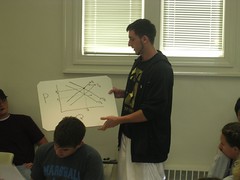
This summer I ordered ten little whiteboards,18 by 24 inches each. They arrived last week, just in time for our discussion of the theories of supply and demand. As usual, I spent a day and a half presenting the theories, Using Whiteboardsand then showed how they could be used to analyze events that affect any markets. Next, I gave the students a series of problems and asked them to work thru them in pairs. In the past, the students would solve the problems on paper. Then I would invite one or two groups to the class’ board to present their results. This time I passed out the whiteboards and asked the groups to solve the problems on the whiteboards. I then selected two groups to stand and present their results, the first to present and the second to critique the first’s analysis.
More using whiteboards

(With 40 students in the class, half the groups had a white board for each problem. After each problem, the whiteboards were passed to the other groups. For one problem, I ended up choosing a group without a whiteboard to present using the classroom whiteboard, to make sure that everyone was doing the problems.)

I really liked this approach and think it worked better than my previous approach.

The whiteboards feel to me like a different space, a different medium than paper in a notebook. One of the problems I observed when students did this exercise on paper was that they tended to draw the graphs too small to see what’s really happening. This is a problem since the graph, when drawn correctly, shows the answer to the problem. The individual whiteboards solve this problem, since the work being done is much larger. It’s also easier for me to see and supervise what the groups are doing without disturbing them, since I don’t have to get so close.

The whiteboard exercises also feel like a more active type of learning, where notebooks tend to be more passive since they are normally used for simply recording what is said. Not to get too touchy-feely, but the whiteboard and markers are symbols of power in the classroom. With the old approach, the students tended to approach the class whiteboard gingerly as if they were aware it was really the instructor’s medium. With the individual whiteboards students seem to take more ownership.

Posted in Teaching and Learning | 5 Comments

Not your parents’ elementary school

This evening I attended a meeting at my kids’ elementary school where they (a 4th and 6th grader) are participating in the accelerated math program. It was a very cool meeting, designed to help parents understand the program and understand what they can do to help. As good as the general curriculum is in Fairfax County where my kids go, the accelerated math program is even better. Here’s what they told us:

* The most important thing you can tell your children about this course is to ask questions! Students don’t like to ask questions, especially in math. We want to change that culture.

* This course is about learning. We want the students to learn and we want students to enjoy what they’re doing. [Implication: This is not about grades. They didn’t say anything about grades. ]

* We’re trying to build a “Community of Learners.” [I’m not kidding–they used those words.]

* In this course the students teach each other. They enjoy it.

How are these kids going to react when they get to college and find it’s a step backwards in terms of the pedagogy? We have six or eight years to get it right for my kids.

Posted in Uncategorized | Leave a comment

(When) Is a College Class More than a Class?

A year ago, Gardner and I began developing what we called an “alternative subversive advising curriculum” for first year students. Like many schools I suspect, ours was struggling with how to create an advising program that students would find value in. Gardner and I came upon the idea of using advising meetings to host a meta-conversation about higher education, and last year we made a good start at finding appropriate discussion topics.

I am now working on an idea for the second advising meeting this year, to be held in early October. The purpose of this post is to solicit your feedback on the idea, which I describe below.

I plan to start the session by reminding the students that at the first meeting of this year, I asserted that freshman year should be more than 13th grade. What I plan to do then is explore the extent to which their experience to date has confirmed or refuted that assertion. I’m going to do this by asking them to write for a few minutes and then discuss the following questions:

* Write down a list of all your courses.
* Which one is the most like high school? Why?
* Which one is the least like high school? Why?
* Which one(s) do you not find interesting at all? What is your strategy for dealing with your lack of interest?

These questions are preliminary to what I really want the students to consider and wrestle with:

* What should a student’s responsibilities be when they take a college course? Is a student responsible for anything more than coming to class and completing the assignments?

I plan to introduce Gardner’s Apgar at this point, which I used in my First Year Seminar this week for the first time. (I plan to have the FSEM students take it every week or so this semester.)

Can any of you suggest a short text I could assign in advance to inspire student thinking about this fundamental question?

– – – – – – – –

The first day of class for my FSEM, which is on globalization, I asked students to rate their interest in the topic on a scale of 1 to 5, where 1 indicated indifference and 5 indicated passion. One student spoke up, saying

I have to tell you that I have no interest at all in globalization. The only reason I signed up for this course is that it had the last open seat of any FSEM when I registered. [Taking an FSEM is required in our new general education curriculum.] I hope you will give me credit for honesty.

While not responding to her explicitly, I stated what I had planned to say to introduce the course, that this course was not about grades or credits, but rather about genuine intellectual inquiry on a topic. That it was more about exploring questions than finding answers. And that anyone taking this course to satisfy a requirement, or anyone not interested in globalization likely would find this course frustrating.

The student’s admission unnerved me. Since then, I have been pondering what to do about it. It is as if having her in the course will inhibit the rest of us from building the genuine intellectual experience that I have planned. Still it’s unfair to put all the blame on her. What about other students who may have felt the same way, but didn’t admit it? Her public admission may have simply made it harder for me to maintain the fiction that my students are genuinely interested in making this course something bigger than a requirement. That fiction is important. Consider how we teach children to eat vegetables. If I claim that vegetables are tasty, and my children humor me by eating them, at some point they will discover that I’m speaking the truth. But if they don’t humor me and they don’t try them, they probably won’t.

I’ve decided to treat this student as a challenge. Can I convince her that school can be something more than a set of requirements? At present I am not particularly hopeful, but I’m going forward anyway.

– – – – – – –

It seems only fair to conclude the advising meeting with the following question:

* What should a teacher’s responsibilities be when they teach a course? Should the teacher be responsible for more than presenting the material on the subject of the course and testing students on their recall of the material?

Margaret Soltan at University Diaries spoke to this recently:

The point of college – the point of professors – is to spark in students an awareness of an intellectual world …; it’s to take students largely unaware of the depths and delights of serious reflection and inaugurate them into it. Of course students are free to take this or leave this; but the fundamental point of higher education is to display it, to seduce students toward it.

Posted in Uncategorized | 8 Comments

Engaging the Net Generation

The other week I had the opportunity to give a keynote address and workshop at the opening faculty meeting at Manchester College in Indiana. I particularly appreciated this invitation because it gave me a chance to do something I’d never done before, namely, to sit down and think through what I believe higher education has the potential to be.

I am happy with the product of my thinking, the notes of which I attach here for anyone interested. Be forewarned, that the segue between keynote and workshop isn’t very clear in the notes.

The trip was enjoyable and the hosts were very gracious. I’ve heard back from several with follow-up questions and comments.

One of the things I tried to do in the presentation was model some of the pedagogies I argue for. I think my intent was sound, but the presentation itself didn’t go as well as I had wished. I forgot to mention to my hosts that I needed internet access for the presentation which was on my laptop. The presentation included about a dozen links out to the internet, which I ended up having to jury rig in real time.

In retrospect, I realize that the world in which I live and work (home and school) is one with ubiquitous wireless access. I simply didn’t think about that. I teach my students that they should always have a backup plan when dealing with technology, and that if at all possible, they should practice on the actual equipment they will be using for their presentation. I wasn’t able to do that, and the presentation suffered as a result.

manchester-keynote

Posted in Uncategorized | 1 Comment

Making Macro Relevant

I’ve never bought the notion of the syllabus as a contract between instructor and student, though I know it’s commonly accepted. Rather, I think of a syllabus more as a travel plan–it’s an outline of where you plan to go, but it doesn’t preclude taking interesting side trips, or even more substantial ones. That said, I’m regularly surprised by how difficult it is to make substantial changes to the way one has always taught a course, especially for standard courses.

My colleague at SUNY-Oswego, Bill Goffe, wrote a fascinating paper last Fall, which sketched out a fairly radical departure from the standard principles of macroeconomics course. One thing that struck me was how different the major course topics were ordered, and how at least a few of the topics I’ve always had in my course were omitted. My gut reaction was I couldn’t teach a course like that.

A couple of weeks ago, I wrote a note to myself, asking if I couldn’t exploit the fact that this is an election year in teaching my macro principles course this semester. Couldn’t I use the election as a lever to make macro more relevant to my students? A week ago Sunday, that is, the day before classes started, an idea popped into my head: What if I reorganized the macro course around the economic policy positions of Senators McCain and Obama? Ironically, Jennifer Imazeki, an economist at UC-San Diego was thinking about a similar thing for her principles of microeconomics course. Since some of the policy proposals are macro in orientation and some are micro, there’s room for both.

I didn’t know what such an approach would involve, but I pitched it to the class the first day. They seemed receptive to the idea, so I told them not to print the syllabus yet, while I mulled the idea over. The main problem is that we would have to reorganize the course outline to explore the topics normally done at the end of the semester, before November 4. What about all the prerequisite material? Would we have time to study enough of that to make the policy analysis viable? And what would we do in the course after the election?

I’ve decided to tentatively proceed on this path, taking it one step at a time. Last week, I asked students to work in small groups to research the economic positions of the two candidates, and to write a one page summary of each. I took their submissions and condensed them to a single concise statement of each candidate’s position. [These are posted on the right sidebar of the course website. Suggested improvements to the language are welcome!]

Next I asked the students to take one specific policy position and to identify the questions we would need to answer to evaluate that policy. For example, one of John McCain’s positions is that American families need immediate relief from the high gasoline prices. Two questions that we would need to answer to evaluate this position are:

* How are gasoline prices determined?

* What is the role of government in determining gas prices?

I’m going to use those questions in class today to segue into a discussion of the role of theories and models in economic analysis. I’m hoping to get the students to realize that the questions they are bringing to class provide the basis for thinking in terms of models. Since a model is fundamentally a hypothesis, and since a hypothesis is a proposed answer to an interesting question, I plan to tease out from the students a list of foundational questions (such as the two examples above), from which I hope they will see that economic models can provide answers to the questions.

The next step will be to use the list of models we come up with to create an outline for the rest of the course. I suspect this outline will consist of many of the topics we typically explore in macro principles, if organized in an atypical order.

Posted in Uncategorized | Leave a comment

What should higher education be?

First, we will set up a single goal to represent educational success, which will take four years to achieve no matter what is being taught. We will attach an economic reward to it that seldom has anything to do with what has been learned. We will urge large numbers of people who do not possess adequate ability to try to achieve the goal, wait until they have spent a lot of time and money, and then deny it to them. We will stigmatize everyone who doesn’t meet the goal. We will call the goal a “BA.”

So begins a thought-provoking op-ed piece in today’s Wall Street Journal. Is this an argument for or against liberal education?

Posted in The Future of Higher Education, What is Education? | 5 Comments

Example of thoughtful thinking about advancing teaching and learning

Leslie Madsen-Brooks has provided a great example of the kind of post I would flag and redirect to the UMW Teaching Center website if I were in charge–A thoughtful example of progressive thinking about how to improve teaching and learning.

Posted in UMW Teaching Center | 2 Comments

Insights on Fanny & Freddie

This post interests me on several levels: the connected nature of media today; contemporary economic issues, specifically the difficulties being faced by Fanny Mae & Freddie Mac due to the mortgage market meltdown; and the issue of the market system & the social good.

I subscribe via rss to a number of news feeds, including the editorials of the Wall Street Journal. Due to the magic of my feed reader, each morning, with very little effort I can get up to date on the news of the last 24 hours from a variety of perspectives. This is very useful for a teacher of the social sciences. This morning I discovered an article in the Notable & Quotable column of the Journal, which gives a brief snippet of something clever. The article today turned out to be a blog post by Lawrence Summers, former U.S. Secretary of the Treasury, and former President of Harvard University. The post was one of the clearest and most thoughtful interpretations I have seen of the current problems of Fanny Mae and Freddy Mac, the government sponsored mortgage market players. After reading the post, I followed it back to the source, and discovered another nugget: a new blog called Creative Capitalism: A Conversation, which describes itself as:

a web experiment designed to produce a book — a collection of essays and commentary on capitalism, philanthropy and global development — to be edited by us and published by Simon and Schuster in the fall of 2008. The book takes as its starting point a speech Bill Gates delivered this January at the World Economic Forum in Davos. In it, he said that many of the world’s problems are too big for philanthropy–even on the scale of the Gates Foundation. And he said that the free-market capitalist system itself would have to solve them.

This is the public blog of a private website where a group of invited economists have spent the past couple of weeks criticizing and debating those claims.

How cool is this? One might even call this a form of scholarly activity. 😉

The premise of Gates’ speech was that the power of the market system can and should be applied to solving the substantive problems associated with economic development, from educating women to erradicating disease to developing effective financial systems. Can the market system, which is predicated on personal gain, be effectively used for the social good? Check out this blog to find out.

Posted in Blogging as a Teaching and Research Tool, Economics, What is Education? | 3 Comments